The world is always ending somewhere. It just depends on whether it falls in your line of vision or not.
Akweaka Emezi
As I have written several times in these posts, I grew up with a view of Mt. Rainier from my bedroom window, and it never failed to delight, especially when the morning sun cast a glow on its snow covered slopes. I cannot remember how old I was when I learned that it was a volcano, probably in school. We were told that the volcano was dormant. I even recall hearing the word extinct, meant to assure us, I suppose, that the nearby mountain presented no danger.
By that time in my childhood I had already come to regularly question what adults told me, especially when there were inconsistencies in their reports. Mt. Rainier may have been “extinct,” but this “harmless” volcano emitted steam from its summit, as I had learned from a book about climbing the peak.
Many years later I had two grandsons who grew up in Puyallup and attended the high school there, less than a mile from the river that would swell with hot silt and glacial melt should Mt. Rainier erupt. They had much more enlightened lessons about the mountain, and along with school shooter drills and the usual fire drills, they regularly experienced “volcano drills.” I do not know what this involved, only that they were advised to stay at the school and never cross the Puyallup River. Fortunately for my grandsons, they grew up in a time when children were no longer shielded from dangerous truths about the world. I had to figure these things out for myself.
As a young woman I vividly remember the eruption of Mt. St. Helens. My husband and I lived in Federal Way at the time, just south of Seattle, and well north of the ash cloud that would be seen and felt all the way to Montana. The gray cloud blinded drivers and choked anyone who had the misfortune of being in its path. We watched with awe as the ash cloud and steam rose high above the Cascades to the south. We had two small daughters. We took them for a bike ride that day to a point where we could all get an uninterrupted view of the spectacle. I wanted them to know about the power of the earth, about the way it rumbles and sends up steam and ash. I wanted to be honest with them.
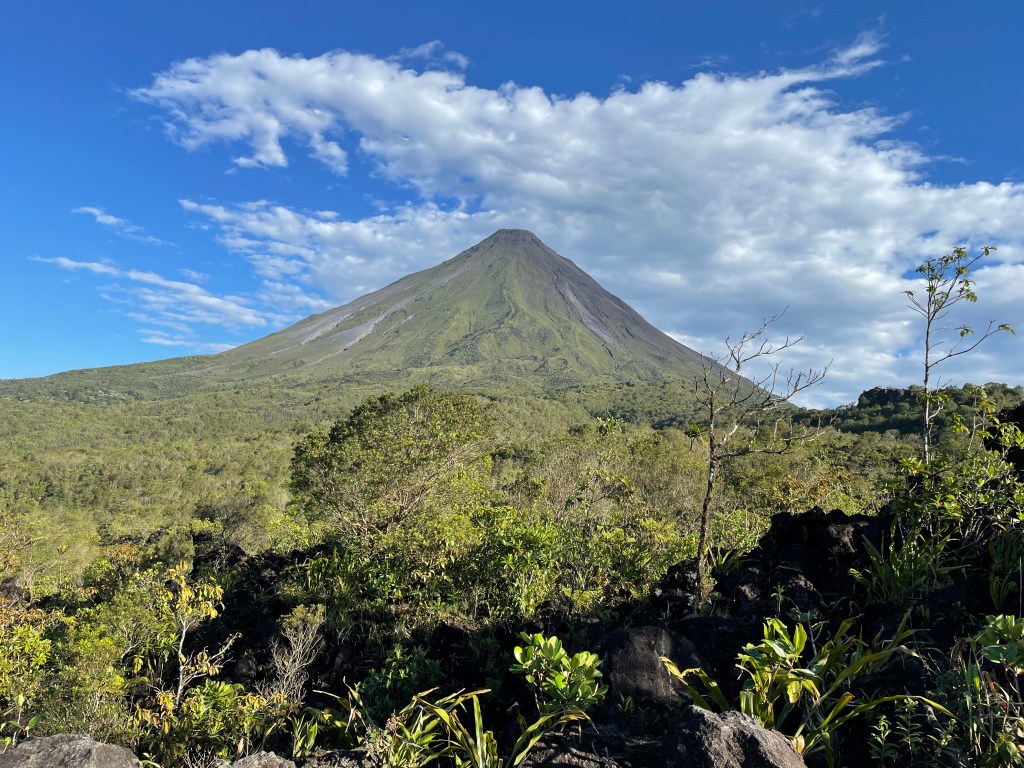
Hiking in the Cascades means being up close and personal with mountains that are part of the Pacific Ring of Fire, a 25,000 mile long stretch of peaks and faults that encircle the Pacific Ocean and includes 750 to 915 volcanoes, depending on how the distance is calculated. The photo above is of Mt. Arenal in Costa Rica. On my recent trip there, we stayed in the town of La Fortuna, which means “the fortunate” because when the mountain erupted in 1968 the lava and ash flowed and blew in the opposite direction from the town, killing three hundred people but not the fortunate ones.
One of the best things about the Pacific Crest Trail is that it takes hikers on a long stretch of volcano viewing, some of them very close. It is the only National Scenic Trail that provides such an experience, and it is one of the best features of that trail, beginning with Mt. Lassen in northern California and continuing north to Mt. Baker, a few miles south of the Canadian border.
In 2015 when I hiked the Washington section with my daughter we stopped and rested when Mt. St. Helens first appeared in the west. Two thru hikers took off their small packs to sit down and chat with us, as hikers often do. As an old woman even then I could not resist reminiscing about the day the mountain erupted and what it looked like before that day, perfectly symmetrical and glistening with snow. They were not aware that they were looking at a live volcano, nor did they know its name. Like many thru hikers they lacked a map and instead were using one of the popular trail apps to navigate the long trek between Mexico and Canada. Their goal was simple: to hike the length of the trail as quickly as possible. Naming the peaks and knowing about them was not necessary to accomplish that goal.
By this time they had hiked by more than a dozen volcanoes near the trail, but they did not know that, nor did they seem to care. Instead they listened to music and podcasts with earbuds as they hiked, adding that it eases the boredom of their long days of hiking.
I will admit there are times when the long treks seem tedious, but boredom never lasts long for me. There is a volcano nearby, and at any minute it may spew lava and ash into the air, causing the glaciers to melt and mowing down the surrounding forest with a blast of heat. I must pay attention. I do not want to miss the show.
 The Solitude Trail
Hi. A volcano going off or an avalanche
<
div>lily or a beautiful stre
LikeLike
Very nice piece. My folks were living in Alberta when Mt. Ste Helen’s blew. There was ash everywhere they said. I was back East studying. I remember the National Geographic article.
LikeLike