Because children grow up, we think a child’s purpose is to grow up. But a child’s purpose is to be a child. Nature doesn’t disdain what only lives for a day. It pours the whole of itself into each moment. . .Life’s bounty is in its flow. Later is too late.
Alexander Herzen
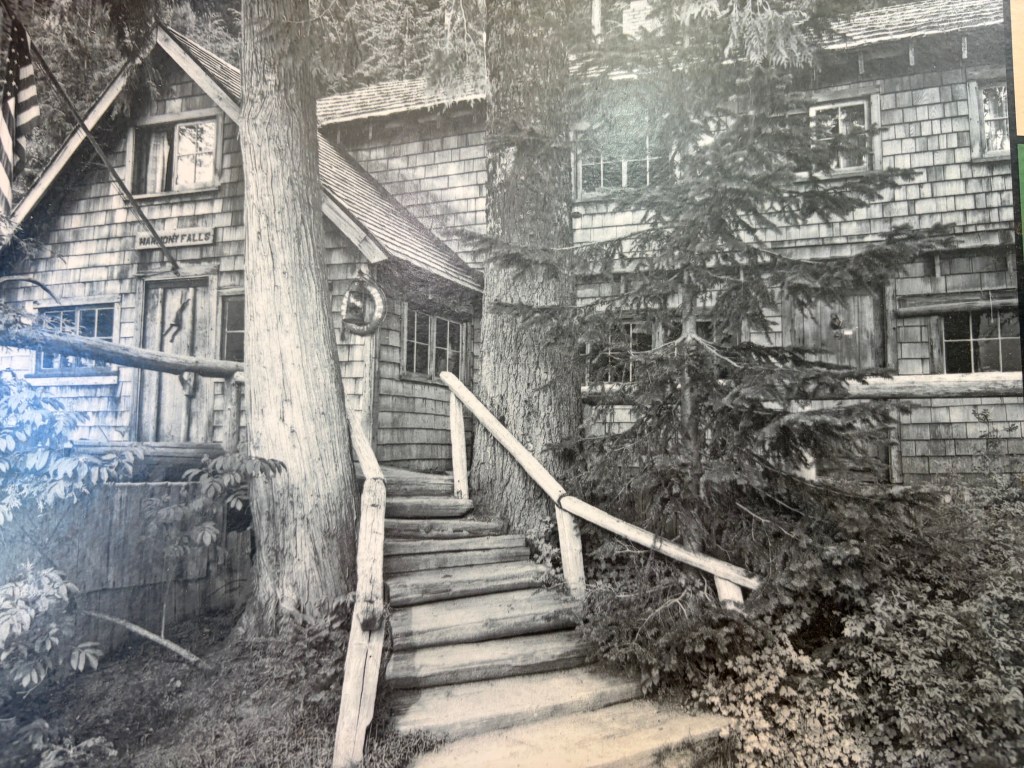
I have written in previous posts about my yearly camping trips to Spirit Lake as a child, about savoring the aroma of huckleberry dumplings simmering slowly over the fire, learning to waterski, hiking the Mt. Margaret loop, living in the woods for a couple of weeks.
I believe those yearly trips were perhaps the most formative of my life. They brought to me a love of hiking, a love of wild and beautiful places, most importantly a kind of comfort in being alone in the woods. I was never afraid of hiking alone. It taught me a lesson that has stayed with me and which I still cherish.
We always camped at a backcountry campground called Donnybrook. It was accessible only by boat or trail, so it was somewhat isolated. We trailed our Sabrecraft to the lake each year, packed it carefully with our camping supplies and groceries, and settled in at our favorite campsite for the next couple of weeks.
Because it was impossible to pack sufficient groceries for two weeks, we made frequent trips to a resort at the northeast end of the lake. Harmony Falls Resort had a small grocery store in the lovely old lodge. It also rented rooms in the rustic lodge and cabins. Guests arrived by boat. They rode the Ruby across the lake. My family would sit at our campsite at Donnybrook on the lake’s edge and remark, “There goes Ruby,” as if it were a new event. It was one of many rituals that came to define our experience there.
Another ritual consisted of the daily walks to buy groceries. After a few years that trip became my responsibility. I always happily volunteered so that I could experience the satisfaction of the short hike that followed the shoreline of the lake. My mother would give me extra money so that I could buy myself a treat. I would sit at the far end of the dock, dangling my feet in the cold water, and drinking my Grape Nehi.
It was from that vantage point where the iconic photos of the lake were taken, Mt. St. Helens rising majestically in the background. The mountain was a perfectly symmetrical volcanic peak, often compared to Mt. Fuji. Those were precious moments in my young life, moments I still cherish and that have shaped who I am today. That is where I learned that simply sitting and gazing at a beautiful vista was enough and would always be enough.
You know how the story ends. Most everyone living in western Washington on May 18, 1980 remembers the eruption of Mt. St. Helens in the same manner that we remember the Kennedy assassination or the downing of the Twin Towers. The ash plume was visible as far north as Seattle, where my husband and I had taken our three-year-old twin daughters on a bicycle ride. We could look south and see the ash cloud rising but did not hear the news until we returned home. My husband promptly turned on the news and there on the television screen was footage of the muddy and swollen Toutle River, the closing of Interstate 5 as fear of the bridge collapsing arose. Then began the interviews with people who had been close enough to see the devastation but not too close. Those people were all killed.
Even after watching the footage of the mountain erupting sideways, shown over and over again, I could barely take it in. I remember suggesting to my husband that we consider going on a drive the next day, perhaps taking a picnic lunch, which we would eat on the shore of Spirit Lake as we surveyed the changed shape of the mountain. “I don’t think that would be a good idea,” he said. He was right.
It would be several years before I returned to the area. My husband and I were divorced by then, and I had taken my daughters on that picnic lunch I had wanted to do on the day after the eruption. It was a long drive. The National Monument had been created by Jimmy Carter, but there was little infrastructure in place. There was no way to get to Spirit Lake. Instead we drove through the “area of devastation.” I tried to tell my daughters what it had been like on that day the mountain erupted, how I had camped at Spirit Lake for so many years as a child. They were more interested in their sandwiches, in the coloring books I had packed for them to keep them occupied on the long trip. I had dreamed of taking my daughters to that place I loved, but that place no longer existed.
On my recent visit to the National Monument I purchased a few postcards at the visitors’ center. I looked at them one by one as I prepared to write this post. The last one I picked up was of Spirit Lake and Mt. St. Helens, the view changed but still familiar. The log raft that covered the lake for so many years is gone, and the reflection of the asymmetrical mountain appeared perfectly on the mirror-like surface of Spirit Lake. The photo was taken from a place that is now called Harmony Point. There is no lodge of course, no waterfall, no dock. And there is no little girl sitting on the dock, only the memory. She is drinking a Grape Nehi.


Thank you for sharing this memory Colleen. It’s very timely for me. I spent yesterday morning under the crater of the mountain for the first time, trying to image what that area looked like before 1980. My hike was both beautiful and humbling. Your share made it even more meaningful. 🥾
LikeLike
I loved camping there also. It was well named. ❤️JSent from my iPhoneOn Oct 12, 2026,
LikeLike