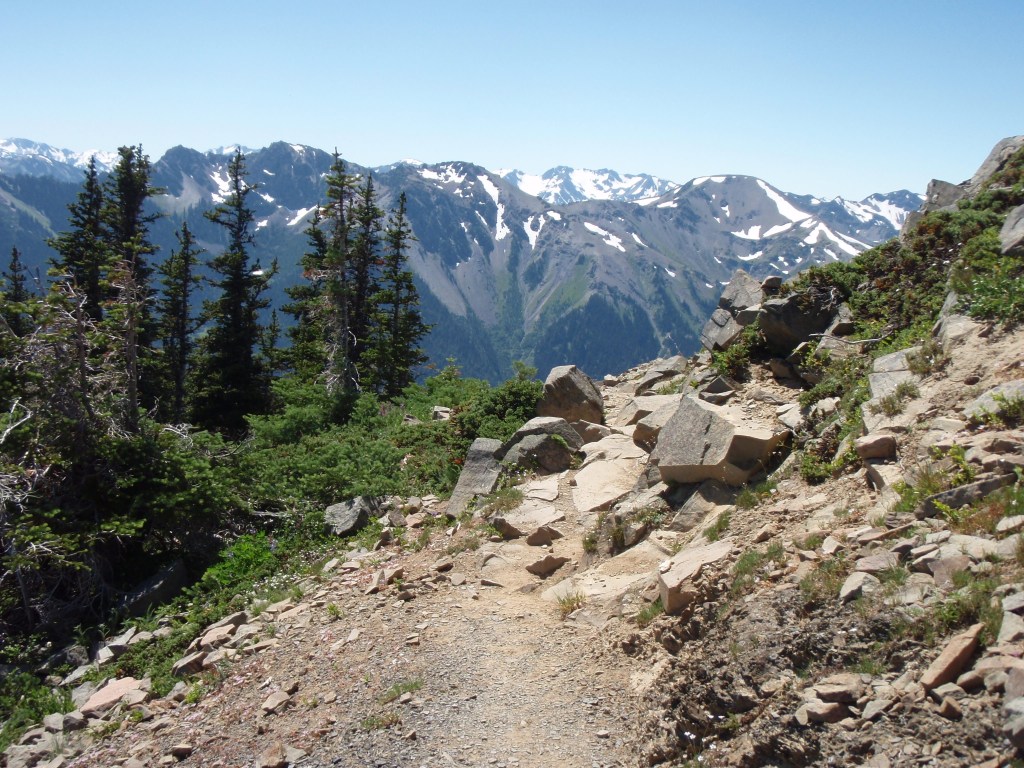
O’Neil’s conclusions were the same as those of the Press party. There were (sic) no great central valley, no prairies in the interior, no lost Indian tribes. There were only mountains and more mountains in every direction. . .adding that it was so mountainous as to be of little use “except perhaps,’ he wrote, “as a national park.”
Ruby El Hult in Untamed Olympics
The book quoted above was published in 1954. My mother had a copy and must have found it to be interesting reading, for she talked about it many evenings over supper with my father, and although I was quite young, I listened to the conversation with rapt attention. It was a place I knew something about, for we camped there every summer.
I have written about many of those camping trips. Most often we pitched our tent by one of the rivers in the park: the Skokomish, the Dosewallips, the Sol Duc, the Duckabush. It was not necessary to reserve a campsite in those days, nor did it cost money to camp there. People pitched tents. There were no RV’s or hook ups. We rarely saw anyone else on the trails. My mother and brother and I would walk up the trail a mile or two while my father followed the more rugged trails to high mountain lakes to go fishing. We would eat a picnic lunch as we sat on the river bank. I remember those days clearly, for they represented my first hiking days. Those days on the trail, while still so young, literally changed my life. I have been hiking and backpacking ever since, and now that I am in my seventies that represents a very long time indeed.
The book seems to reappear every few years in my life, usually when I am moving and have discovered a long hidden box of books. I reread it every time that happens, always surprised by Lieutenant O’Neil’s apparent disappointment that there were no hidden valleys, no lost Indian tribes, no prairies, only “mountains and more mountains,” as if that should be insufficient.
Before O’Neil and others crossed and explored the interior of the Olympic Peninsula, local Indian tribes believed it to be inhabited by the Great Thunderbird and did not go there, confining their hunting to the river valleys that spread out from the interior like spokes on a wheel. For some reason early white explorers thought the interior held some mysterious geographic feature, a large lake perhaps or a great prairie, thus the disappointment when they only found mountains and more mountains.
It is interesting how often early explorers would search for something they wanted to be there, lacking any evidence whatsoever, disappointed when their search did not reveal the hidden treasure. The Northwest Passage is a good example, a body of water that crossed the continent, allowing passage between the two oceans. It did not exist, but that did not stop explorers from seeking it.
One of my last backpacking trips in those mountains was a long traverse from the Skokomish River to the Quilcene. It was like spanning a picket fence, taking me up the Skokomish to the Low Divide, down the Duckabush and over LaCrosse Pass to the Dosewallips. Then began the very steep ascent to Constance Pass and down the Dungeness, finally climbing still more steeply to Marmot Pass and down the Quilcene River, where my husband met me at the trailhead.
I remember that trip as one of the best ones I ever took, though I do not know why. It rained almost every day, and time in camp was spent in my tent reading a book. I had brought along Peter Mathiesssen’s The Snow Leopard, another one of those books I reread every few years. He was seeking something on his journey through the Himalayas, a magnificent animal that actually exists but is rarely seen. He did not find it. Like most of our journeys he found something he had not been seeking. It is often like that on the trail.
Like Mathiessen I was seeking something on that trip. I think it was just sunshine and an escape from the confines of my tent and the gray skies. I did not find it until the last day, when I was treated to a clear view of the eastern Olympics and the Needles as I crossed Marmot Pass. There it was. . .mountains and mountains and mountains. I was not at all disappointed.
 The Solitude Trail
Your essay brings back following the PressExpediti
LikeLike
Thanks Jan, I thought about that trip when I wrote this piece & thought of including something about it but thought it might be a distraction. More on the Olympics to come.
>
LikeLike
Delightful… would be neat to see these published in hard copy something like Annie Dillard’s “Pilgrim at Tinker Creek” and her others. Thank-you.
LikeLike