Each step of a journey enters and alters the person who makes it.
Jane Hirshfield
I do not usually go hiking in November. By this time of year it is typically well below freezing when I awaken in the morning and warms up only a little during the day. I seem to be less tolerant of the cold as I age, along with many other things. Fortunately for me there is down and wool and a steep trail that warmed me up almost immediately as I took my first steps. As always, the trail softens my cold thoughts and brings me healing.
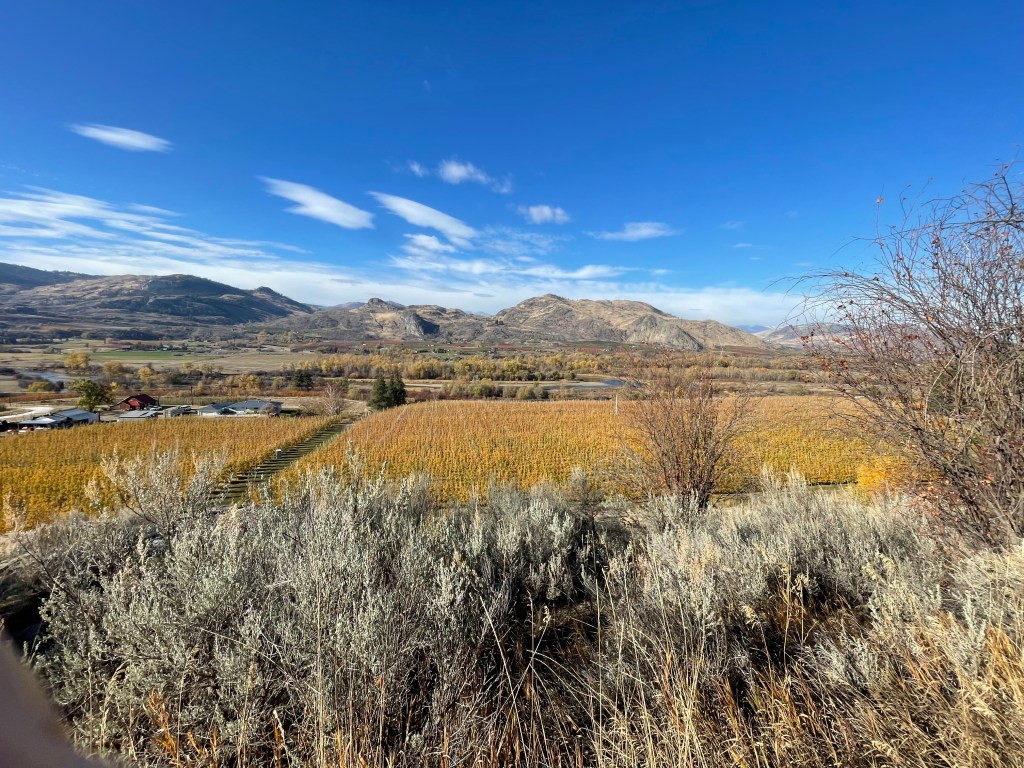
I had a whole day to spend in the Okanogan Valley after dropping my dog Lulu off for minor surgery in the morning at the veterinary clinic. She would spend the day sleeping, while my other dog Bruno and I would go hiking. We drove north to the Whistler Canyon Trailhead, a section of the Pacific Northwest Trail and not far from the town of Oroville, which is the halfway point of the trail.
I remember when I hiked the PNT in 2018 I especially liked this section, though most hikers would not consider it spectacular when compared to the jagged peaks of the North Cascades or the distant glaciers in the Rockies. The Okanogan Highlands represent the westernmost range of the Rocky Mountains, and the valley is the only place where the Rockies and the Cascades meet in an inverted V at the north end of the valley. The westbound hiker will get his or her first close up view of the Cascades, will cross the Okanogan Valley, and will soon enter the magnificent Pasayten Wilderness, which spans the eastern North Cascades. This is a transition zone. The trail smells like sage, and rattlesnakes are frequently seen. There are orchards that hikers will soon encounter, the proud producers of Washington State Apples.
For the hiker who pays attention, who observes the plants, the geology, the subtle changes in the climate, there is a lot to learn on the Whistler Canyon Trail. When ebooks came into existence I downloaded all of my favorite field guides as well as a geology textbook. For me it has never been enough simply to place one foot in front of the other. On evenings in camp I like to look around me at the landscape and then pick up my phone to read about whatever I find interesting, which is pretty much everything. This is one of the things I miss most about long-distance thru hiking: watching the changing landscape, observing the difference in the forest canopy, and watching the changes in myself as I make the long trek from one end of the trail to the other.
This was not a long hike, but I was nevertheless able to observe the changes in myself as I walked. It was the first hike I had taken since my husband’s sudden death a little over a month ago, and it was the first time I experienced something I can vaguely describe as healing. The air was fresh and clean and smelled like sage. The act of working hard to climb the steep western face of the canyon reminded me that I am a strong woman. The trail has taught me that as well as many other things about myself and the world. Somehow I always seem to make it to the top, however impossible the climb might seem when I am trying to estimate how many switchbacks there will be. How many this time? Too many to count. There is no field guide that tells us how to grieve.
Colleen Drake (AKA Teacup) has over sixty years of hiking exerience (yes, I'm really old) and has seen some pretty big changes over those many years. Join her on the Solitude Trail & share some of these adventures while exploring with her the value of solitude in the wilderness.
View more posts
One thought on “Thoughts on Trail Therapy”
Hiking is your medicine of choice. It has always been your drug of choice. J
 The Solitude Trail
Hiking is your medicine of choice. It has always been your drug of choice. J
Sent from my iPhone
>
LikeLike