Let me take my chances in the big outside worldly wilderness with all its sins and sufferings.
William James
In the southeastern corner of Washington State lies a mountain range that few people have ever heard of, even Washington residents. Last month when I began to plan my trip and told friends and family that I was going on a hiking and camping trip to the Blue Mountains, most people just looked at me with a blank expression, and one person even inquired, “You’re going to Australia?”
I do not know why these mountains have remained obscure, but I am very glad that they have. For four nights I camped alone at campgrounds accessible by dirt road. Clouds unfurled in a blue sky when I got up each morning high on the ridge tops, unfettered views of the deep valleys below me. One of these valleys forms Hells Canyon, to the east of where I camped, deeper and wider than the Grand Canyon. There are no views of jagged peaks or glacier clad mountains.
Instead the hiker is surrounded by those long ridges which extend far to the horizon in all directions. From the highest point, Oregon Butte at 6387 feet above sea level, the vistas extend south to the Oregon Wallowas, hence the name of the butte. Here there is a lookout tower, still staffed each year by a woman named Julie who makes her home in that beautiful place from spring to fall, not coming down for the entire season. Why would she want to? She has the best room with a view I have ever seen, and though she has regular visitors who hike to the summit as I did that day, like these mountains, the trails are never crowded. I saw no other hikers on any of my hikes in the Blues.
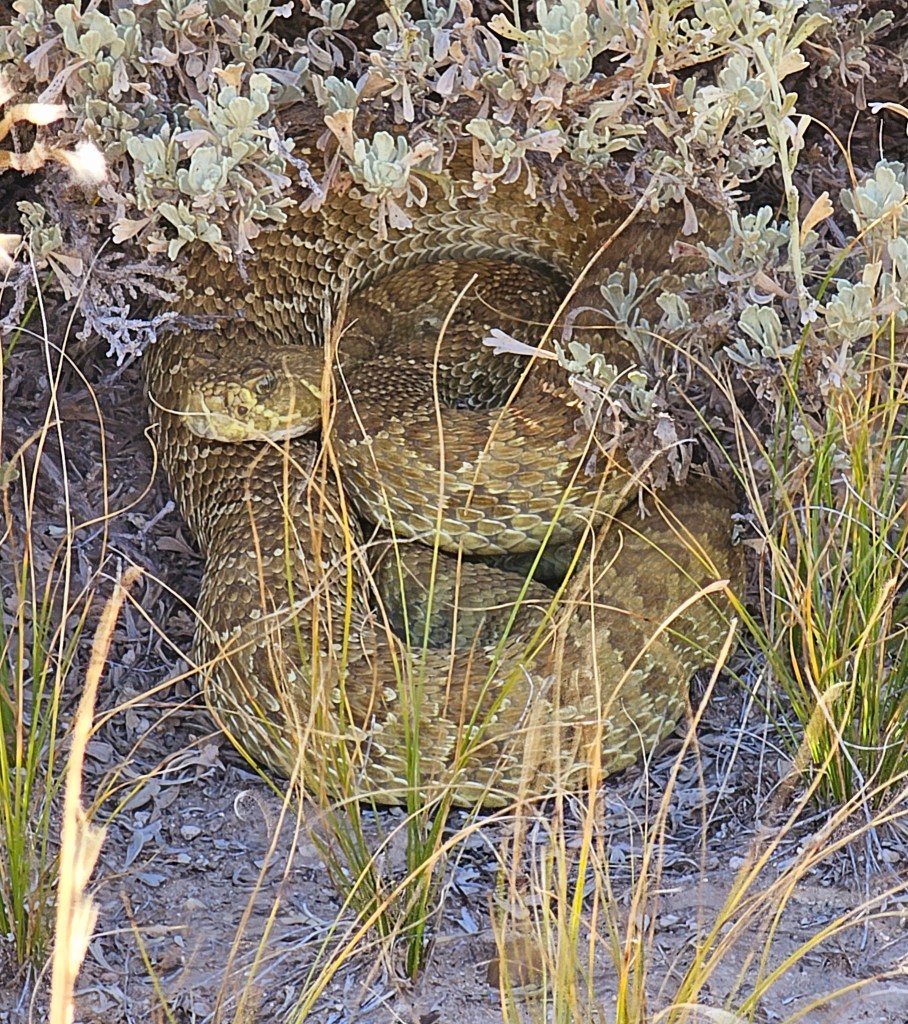
For a hiker who loves solitude, these mountains are paradise, and like any good paradise, there is a serpent in it. . .actually lots of them. Pick up any trail guide with descriptions of hikes in the Blues, and you will find these three words: crawling with rattlesnakes. Some of the place names are a dead giveaway: Rattlesnake Butte, Rattlesnake Trail. I came to exercise caution when hiking switchbacks. It was common to see one on the trail as I rounded the corner, and then another one would appear at the next turn. And by the way, they do not sound anything at all like the rattlesnakes in a John Wayne western, more like a really loud white noise machine. It is hard not to like a creature that does not really want to bite you, and does its best to give you a loud warning as you approach.
Liking rattlesnakes is probably an exaggeration of my feelings toward these reptiles. I would not like to cuddle up with one in my sleeping bag or anything like that. But I like them for the same reason that I like grizzly bears, and wolves, and cougars, and other creatures that snarl and growl and hiss. I like that they are there, reminding me as a I step around them that I am in the wilderness and the wilderness is a dangerous place. It is the wild in wilderness.
These days as more and more hikers bring technology with them into these wild places, it is easy to forget that it is dangerous out there. Our GPS eliminates the need for a map and compass. If we are bored we can always play a game on our cell phone. And most thru hikers I meet on my long hikes do not carry bear protection or take any special steps to secure their food at night. A bear canister is heavy. It slows them down. Thru hikers are always in a hurry.
And perhaps that is the best part about sharing the trail with rattlesnakes. They force me to walk mindfully, to pay attention, to use caution as I round the corner of each switchback. That is the way I should always be hiking. Rattlesnakes force the issue.
So do not go to the Blue Mountains if you want a neat and clean wilderness where the wild things are in cages. Go there instead if you want to be thrilled, to be challenged, to feel that adrenaline rush when you realize there is a venomous snake a few feet from where you are walking. Step carefully. Be mindful. Be fully present in a wild place and let it change you.
I am grateful to my friend Anne Glenn for allowing me to use her beautiful photo of the rattlesnake. Thank you Anne.
 The Solitude Trail
Wow. I think the Blues will stay
Without too many hikers after
<
div>reading that. They will want to avoid the rattlesnakes. Impressive. Jan
Sent from my iPhone
<
div dir=”ltr”>
<
blockquote type=”cite”>
LikeLike