As people who want to live a good, full, unrestricted, adventurous, real kind of life this is certain instruction we can follow: see what is.
Pema Chodron
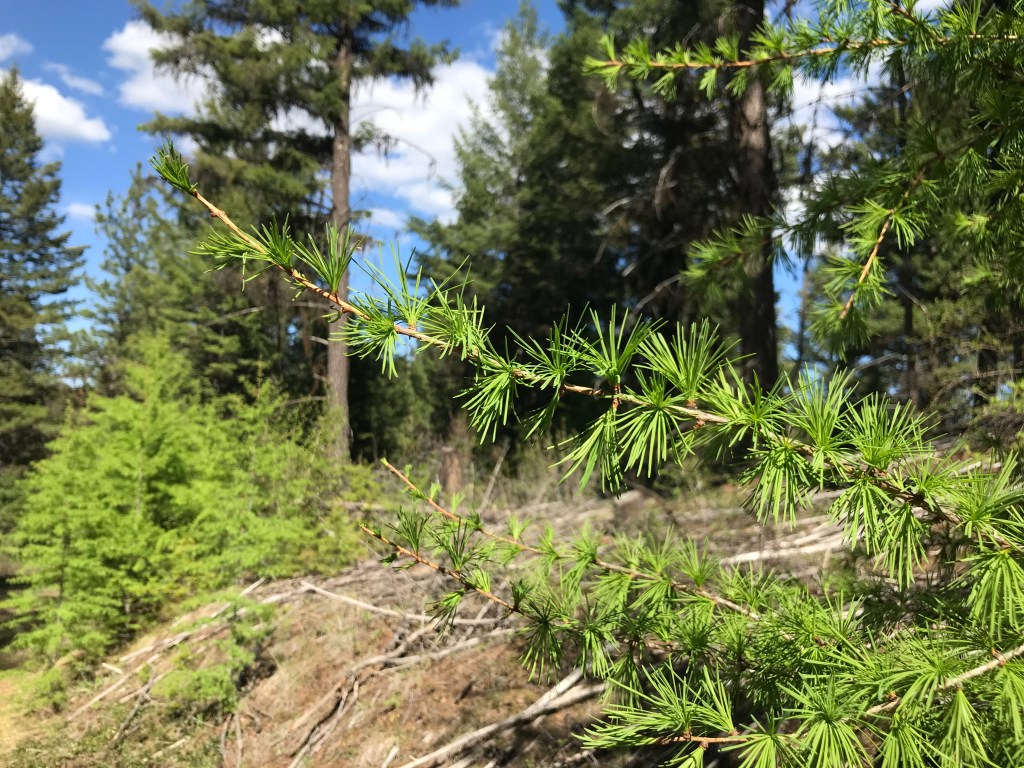
I encountered my first subalpine larch tree on a backpacking trip in Washington’s Pasayten Wilderness, an area I came to love because of its isolation and beauty and to which I returned many times in the years that followed. I had climbed to Billy Goat Pass and sat down to rest and eat some lunch when I looked up and saw the thin limbs with their bottle brush soft green needles. It was the very tree on which the sign announcing the boundary of the Wilderness Area had been nailed, and I immediately recognized them even though I had never seen one before. A recent article in the Washington Native Plant Society’s newsletter had featured these rare and unique trees, and I had begun the trip expecting to see them in the North Cascades, for it is the only part of the state where they occur.
I knew that I was looking at something rare and wondrous. The trees grow only in isolated pockets of the North Cascades and northern Rockies, a range that extends into western Montana. They are not seen even by the average hiker and camper, for their growth is limited to elevations of six thousand feet or higher. There is only one place in Washington where they can be seen from a road, the precarious drive to Hart’s Pass and Slate Peak, not for the faint of heart and certainly not the kind of place the casual tourist or hiker is likely to be found.
There are many wonderful things about these trees apart from their limited range. For starters they are deciduous conifers, a phrase that may seem contradictory, but look up the word conifer, and you will find it refers to the leaves: needle-like or scales. Beginning usually in mid-September they turn into a blaze of gold then drop their needles and remain free of them until the following spring, when the first tentative needles can be found on the knobby branches, soft as down, bright green like spring.
There is another variety of larch tree that is quite ubiquitous where I live, the western larch or Larix occidentalis, also called Tamarack. Their range extends from the eastern Cascades across the western ranges of the Rockies, and because they grow at lower elevations they are much taller than their higher elevation counterpart. They put on a particularly impressive show in the fall because they are typically interspersed with fir and pine, and thus the contrast is indeed dazzling to behold.
But this is not a treatise on forestry but instead a story about privilege, though not the kind of privilege you are probably thinking about. I do not know how many of my hiking readers have had this experience, but it came to me that day at Billy Goat Pass, sitting next to Larix lyally. I realized that very few people would ever see these trees, and it somehow mattered to me that I was seeing one at that moment and that my life was richer because of it.
On that trip I began a tradition of breaking off a larch twig on the last day of hiking and carefully wrapping it in my bandana to keep it intact for the trip home. There I would unwrap it and place it carefully on the small table at my bedside, where I would hold it in my hands every night before turning out the lights.
That was a challenging time in my life. My marriage had ended a few years earlier, and I had finished graduate school but not yet completed the certification requirements to obtain my nurse practitioner’s license. In the meantime I was working weekends at a hospital in Tacoma, getting by but just barely. Various crises would come and go, and there were times I felt that I was not up to the task of raising two girls on my own while I built my career.
I would retire to bed at night, a mattress on the floor, and hold the knobby twig in my hands. The needles quickly turned brown and dropped off, but the larch was still there in my hands, a reminder that I was strong enough to climb to high places, and I had seen this tree growing tall despite the short growing season and heavy snows.
My girls are grown and happy. I have retired from a successful career and now sleep in a bed instead of on a mattress on the floor, but I am also old enough to know that difficult times never really go away; they just change. I am planning a trip to the Pasayten this summer, confident that even in my seventies I can carry my pack to those high places. I need a larch twig at my bedside once again.


🤞you will get one. 😀Jan
Sent from my iPhone
<
div dir=”ltr”>
<
blockquote type=”cite”>
LikeLike
Friends and I, all in our 60’s, are accompanying our 70 something friend on a 10 day backpacking trip in the Pasayten to visit some old haunts, should the fire gods permit it. A special place. Thanks for another lovely essay
Steve
LikeLike
Oh wow, that’s incredible. Thanks so much for sharing this. I hope I’ll have friends like you when I get too old to go on my own.
LikeLike