God sleeps in minerals, awakens in plants, walks in animals, and thinks in humans.
Sanskrit
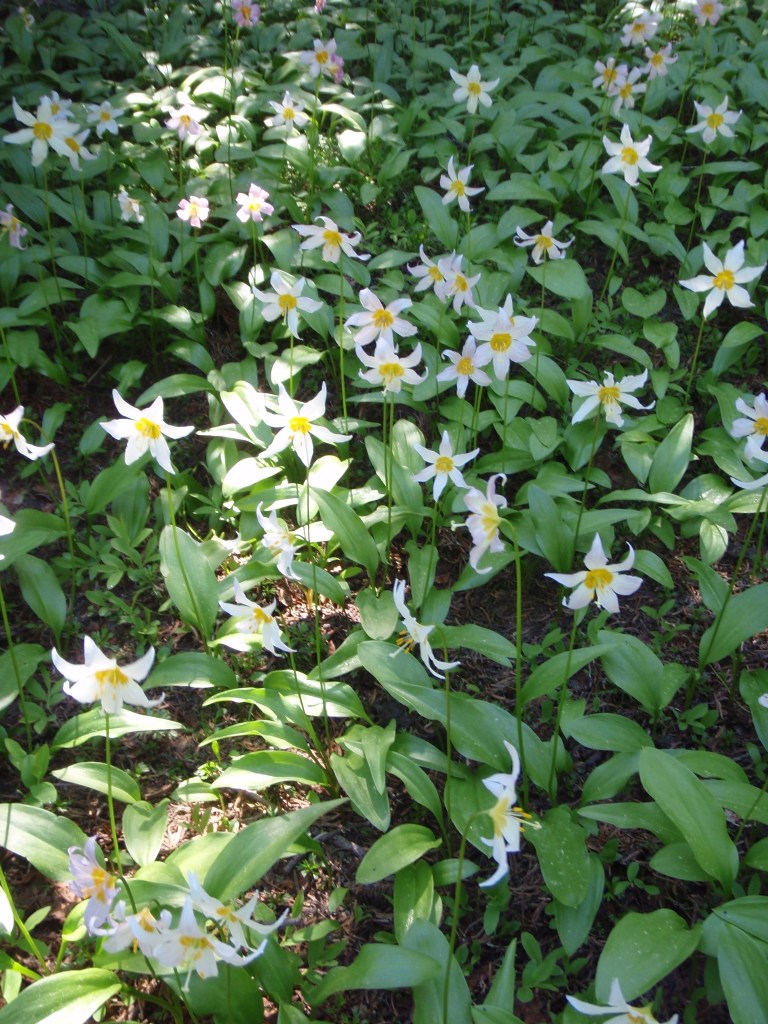
It is an odd day to be writing about flowers, this darkest day of the year, the winter solstice. Where I write to you from the Okanogan Highlands in northeastern Washington snow blankets the ground, and winter storm warnings are in place for travelers this weekend before the holiday. I am no stranger to dark winters, having grown up in western Washington, but this dark December following my husband’s recent death has been a little hard to take. The days seem grayer than usual, or perhaps it is my mood.
To lift my spirits I have been thinking of the Japanese concept, kado, which means the way of being in and with nature. When I am alone in the mountains on my long treks, this way comes naturally. It is the path that I follow, and it is comforting to live in this natural way, to crawl out of my sleeping bag with the first daylight, to prepare my breakfast of oatmeal and a cup of hot tea over my small stove, to watch as the sun rises over the eastern ridge line, and to shoulder my backpack to begin the day’s hard work. There is a comfortable rhythm to this process as there is a rhythm to nature. I wish I could embrace that rhythm with greater ease as I adjust to the new reality of snow and ice and my recent loss.
Fortunately there are flowers to bring color to the world of gray. Of course they have bloomed and faded and now are covered in a blanket of snow. That is the way of nature. That is kado. But their blooms live forever in my heart and come to me during the nights that are dark and cold.
These days when I am consumed by grief I try to resurrect memories of beautiful moments in my life. Because I have hiked and backpacked for over seventy years, this is easy to do. I methodically think about particular trips I have taken, and when the right one enters my consciousness, I will say to myself, “Oh yes, that is the one.” Then I try to recall every detail of that beautiful place. . .how I felt, what I saw…the sound of the singing steam, the profusion of flowers.
One such memory is of Home Sweet Home Basin in Olympic National Park. This trip took place many years ago when I was new to solo hiking. If my memory serves me correctly I was twenty-three-years-old, a young woman finding my way in the world, finding my way on the trail while heavy snow still remained in the high country of those mountains in that summer following a heavy winter snowfall. I had made the long ascent up the Skokomish River Valley to the divide that marks the transition to the Duckabush River watershed. From that point the trail was not visible beneath the snow, but I could see the shelter below in Home Sweet Home Basin, still sturdy and strong in those days, and I had no trouble finding my way down the steep slope. The basin was covered with a large snowfield, but at its edges was perhaps the greatest profusion of wildflowers I have ever seen, as if they could not wait to start blooming as soon as they were able to lift their flowering heads above the melting snow: avalanche lilies, glacier lilies, and marsh marigolds which bloomed in the trickling water from the melting snowfield, the beginnings of the Duckabush River.
I have this belief about life, that the world wants to bloom, that water wants to flow, that beauty is the natural order of things. That was perhaps the first time in my young life I felt it so strongly.
I still hold that belief to be true many years later as I reflect on a lifetime of hiking and backpacking, a satisfying career, two amazing daughters, and a marriage that ended with my husband’s sudden death just three months ago. However dark the winter may be, I have this. Flowers bloomed at the edge of a melting snowfield in 1973, and I was there to behold it. Happy holidays to my readers. Savor the beauty of the season.
 The Solitude Trail