What does it mean, say the words, that the earth is so beautiful? And what shall I do about it? What is the gift that I should bring to the world? What is the life that I should live?
Mary Oliver
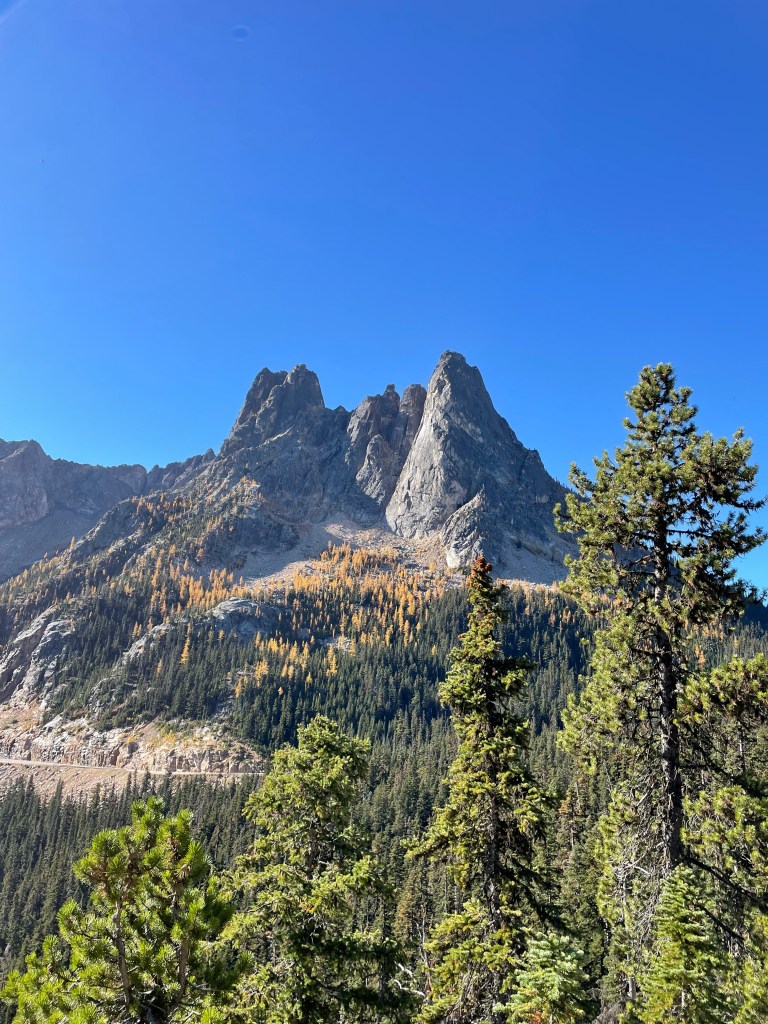
On a recent trip to western Washington to visit friends and family, I took some extra time to travel the scenic route over the North Cascades Highway. It is the route that crosses Washington’s Cascade Mountains not far south of the U.S./Canadian border and is closed during the winter months because of heavy snows and avalanche risk. For the last several years it has also been closed during much of the summer due to wildfires and heavy smoke. This is a great tragedy, not just for the forest, but for the towns that depend on a steady flow of tourist dollars.
On the map this highway is the most direct route across the mountains for me. But nobody ever takes it because they are in hurry. The highway climbs and curves over two mountain passes and through the North Cascades National Park. Drivers stop at various viewpoints to savor the vistas of jagged peaks and the valley of the Methow River extending to the east. The town of Winthrop invites tourists to stroll along the wooden side walks, shop at the many boutiques behind the western store fronts, visit nearby Pearrygin Lake, float the river on a raft, hike, climb, play, just the kind of place I love.
But it is not the ice cream and hot dogs that bring me back to this highway year after year. Though I have now driven it dozens of times since its opening in 1973, it is never ordinary and never will be. I hardly consider myself a tourist. I have hiked most of the trails in the North Cascades and Pasayten Wilderness, so I am familiar with the mountains far beyond the scenic highway. Nevertheless I typically stop at all the viewpoints, walk the short loop trail at Washington Pass, and take photos of the mountains I have photographed many times before.
Take the photo you see above, which is Liberty Bell Peak. In my various photo collections I have views of Liberty Bell shrouded in low clouds, shinning in the sunlight, and in this one ablaze with the golden needles of subalpine larch trees in fall. On the side of the road there are usually several cars parked, as climbers make their way to the summit at 7720 feet in elevation. It is considered by climbing organizations to be one of the fifty best climbs in North America.
The next stop is Washington Pass, where I walk the short loop, reading signs with suitable poetry praising the mountain scenery, glimpsing close vistas of Gardener Mountain and the long sweep of the Methow Valley.
On the west side of the pass lies Ross Lake, a reservoir built by Seattle City Light, beginning in 1937 and not completed until 1949. The lake extends twenty-three miles into Canada and shines teal green from glacial silt. It is not accessible from the highway, requiring a short hike to get to the shoreline, something I have always found comforting, as most travelers will simply gaze at it from high above at a viewpoint and then be on their way. Two other reservoirs, Gorge and Diablo, offer campgrounds and ready access to their shores.
Past the community of Newhalem, a small town that provides homes and administrative buildings for Seattle City Light employees, a turnoff leads to the visitors’ center for North Cascades National Park, more campgrounds, and the turbulent rapids of the upper Skagit River, a popular kayaking site.
What do all these places have in common, and why must I stop at all of them, though I always know exactly what I will see. Quite simply, they are beautiful. On this trip I found myself pondering that question that can almost never be answered satisfactorily. . .why?
Beauty is not limited to mountain scenery of course. Recently I watched a video of Simone Biles leaping and twisting across the floor and was left with that same sense of awe. Again. . .why?
Philosophers have been pondering that question for centuries, and I hardly can claim to add any new insights to all of that pondering. I just know beauty when I see it. That seems pretty simple to me.
There is another question I can answer. It is contained in the Mary Oliver quote that begins this post: What shall I do about it? Another simple one: Slow down. Take the scenic route. Stop at all the viewpoints. Take some photos. Write about it. Paint it. You are here to create. You are part of all of this beauty, and this is the gift you must bring to the world.
 The Solitude Trail
Nice essay. Thanks. Jan
Sent from my iPhone
<
div dir=”ltr”>
<
blockquote type=”cite”>
LikeLike