If you can spend a perfectly useless afternoon in a perfectly useless manner, you have learned how to live.
Lin Lu-T-ang
On a long backpacking trip in the Pasayten Wilderness many years ago, I was setting up camp near Sheep Mountain when a backcountry ranger stopped by to visit. We talked for a long time. Her name was Mary Pat, and we found many things to talk about. Darkness was approaching by the time Mary Pat departed, and she still had to make it to the ranger cabin where she would be spending a few nights. When she left, she gave me this enticing invitation: “When you hike out, stop by Early Winters before you head for home, and I’ll treat you to a cold beer.”
This was a calling I could not refuse, and so a few days later when I had completed my trip and hiked out to Billy Goat Trailhead, I headed west on the North Cascades Highway, where the Early Winters Visitors Center was located conveniently on my way home.
When I walked into the visitors center I was disappointed to learn that Mary Pat had been called out on a fire near Ross Lake, so there would be no cold beer that afternoon, nor anymore lively conversation. Instead she left me a nice note with a book recommendation. The book was for sale there, and I picked it up and removed it from the shelf and saw that it was signed by the author, which added to the appeal. The title of the book was Cascade-Oympic Natural History: A Trailside Reference by Daniel Matthews. I took the book home and read it with the eagerness that most people approach mystery novels.
Yes, I am someone who actually reads field guides. I do not just look thing up, though I do that as well. This one was particularly appealing as it included more than the usual descriptions of flowers, birds, and trees. Within this small paperback with the photo of a flowering alpine meadow on the cover were essays on mammals, reptiles, amphibians, fishes, insects, even volcanoes, to name just a few topics. Here was the world of the mountains in my hand. I was in love.
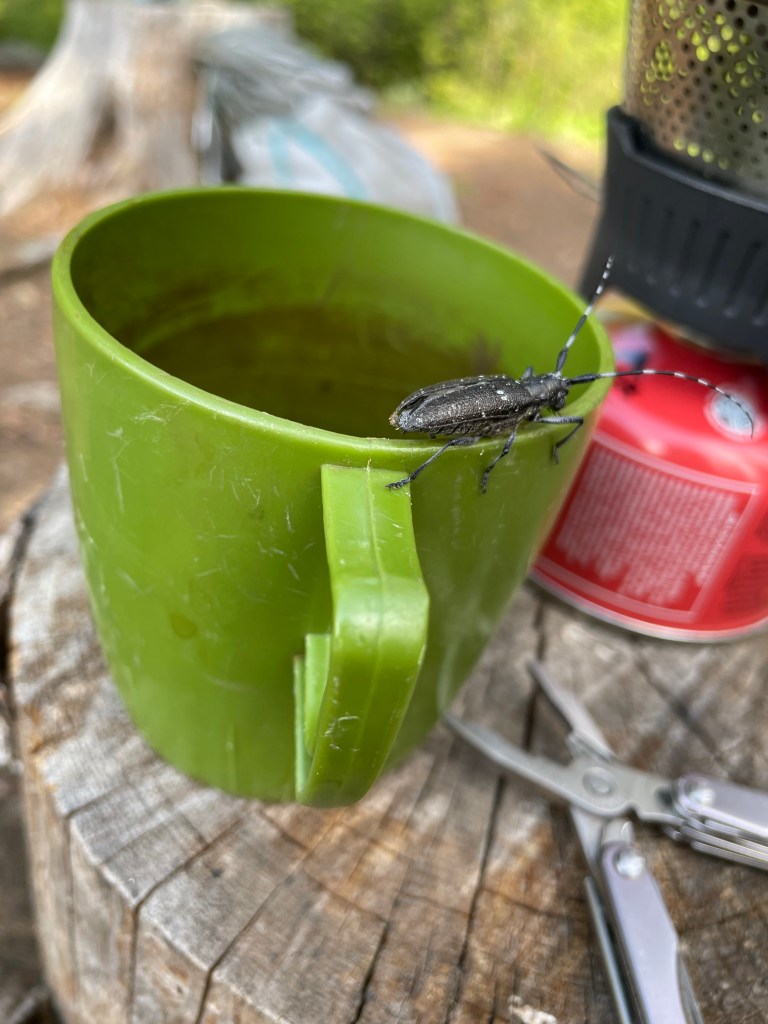
I never saw Mary Pat again. If I had I would have thanked her for the treasure that has been with me for so many years. It has become a constant companion, always in my backpack and placed so that I could retrieve it with ease and look up whatever caught my attention on the trail. Sometimes in camp I would pick it up and thumb through the pages until I landed upon an interesting topic. Even the weather was included, so I would look up at the sky or down at the ground at the small things which are always there, crawling about my feet or sometimes on the rim of my teacup, like the white spotted sawyer beetle you see in the photo above.
The book is now well over thirty years old. It is dog eared and worn, notes in the margins, check marks and dates by descriptions, sometimes a lively comment I have added and always the location where the specimen was identified. It feels comfortable and familiar in my hand, like my green teacup. The book. . .the cup. . and my life is complete.
A few years ago I had to get serious about ultra-lite backpacking in order to lessen the load on my aching joints. I was pleased to find an e-book version of Cascade-Olympic Natural History, though in truth I have hardly used it. Looking something up on an electronic device seems to be more challenging for me, but more importantly it lacks the wear and tear, the comfortable weight of a book in my hands. I do not miss the burden of a sixty-five pound pack, but I do miss the things I used to carry in it.
Like most books it tells a story, but it is not in its descriptions. Instead it is the story of a solitary woman on the trail with a field guide, learning about the world and about life. I am not done yet.
Colleen Drake (AKA Teacup) has over sixty years of hiking exerience (yes, I'm really old) and has seen some pretty big changes over those many years. Join her on the Solitude Trail & share some of these adventures while exploring with her the value of solitude in the wilderness.
View more posts
 The Solitude Trail